The Perfect Hamburger: slow-motion commercial assembly
By Sulat (sulat.com). Model: Kimi K3. Posted date unknown. Original post: https://hamburger-assembly.k3.demos.sulat.com/
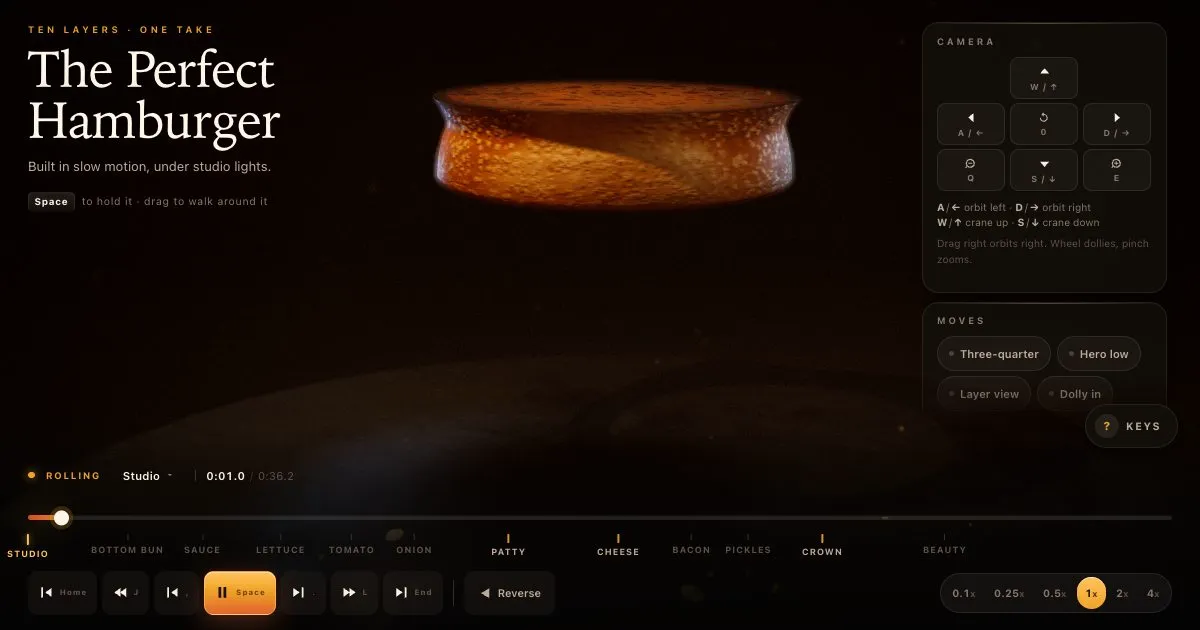
Build a high-fidelity, interactive 3D visualisation of the perfect hamburger being assembled — a browser experience that plays like the hero shot of a national television commercial, where every component floats into place in luxurious slow motion and the viewer holds the remote control. The visitor opens the page onto a burger under studio lights, and the build sequence runs: the toasted bottom bun settles, sauce swirls across it, crisp lettuce unfurls, tomato slices land with a wet gleam, onion rings drop, the flame-grilled patty arrives with sear marks and a shimmer of rendered fat, cheese drapes and slumps into a molten fold, bacon lays across the top, pickles tuck in, and the crowned sesame bun descends and compresses the stack with a soft settle before the whole thing rests in its beauty pose. The visitor can watch it, scrub it, run it backwards so the burger disassembles into a levitating exploded diagram, slow it down to admire a single tomato slice landing, speed it up, and orbit all the way around the stack while any of that is happening.

Make it look like the commercial, not like a diagram. Chase the specific visual language of food advertising: a dark, shallow studio set with a warm key light raking across the top of the bun, a cool rim light separating the stack from the background, deep glossy falloff into shadow, and a shallow depth of field that keeps the hero layer sharp while the background melts. Every ingredient needs its own believable material — the matte-crumb sponge of a bun interior against the lacquered, egg-washed sheen of the crown; the translucent, veined, slightly waxy edge of a tomato slice; lettuce that scatters light through its ruffled thin parts; cheese that reads as soft and heavy and slightly wet; a patty crust that is dark and irregular and craggy rather than a flat brown cylinder. Toasted sesame seeds should sit as real geometry on the crown, the bun should be an asymmetric organic dome rather than a squashed sphere, and the patty should bulge and overhang the bun the way a good one does. Add the small commercial theatrics that sell the shot: steam curling off the patty, condensation beads on the lettuce, a sauce drip that stretches and breaks, crumbs and sesame seeds that shake loose on impact, a slow specular sweep across the glaze, and grease glistening at the edges of the sear. The camera should breathe with a lazy drift even when nothing else is moving, and light should feel physical rather than flat.

Choreograph the assembly with real timing and weight. Each ingredient enters from above with its own arc, its own rotation, its own squash-and-settle on impact, and its own knock-on effect on the layers beneath it — a heavy patty should compress the bun and make the sauce squeeze outward at the rim, a dropped bun crown should push a wobble down through the whole stack, cheese should have a different fall and settle than a rigid pickle slice. Give the sequence a shape: an establishing beat, a rhythm of drops with breathing room between them, a hero slow-motion moment on the patty or the cheese melt, and a final settle into the beauty pose with a slow orbit. The stack should be believable as one object under gravity — layers rest on each other, everything overhangs slightly and imperfectly, nothing floats or intersects, and no two tomato slices or sesame seeds are identical. Every step should carry the ingredient's identity clearly enough that the visitor learns how the burger is built while being seduced by it.

Give the visitor real transport control over that timeline. Playback runs forward and in reverse at multiple speeds, with fast-forward and rewind that visibly accelerate the choreography rather than skipping it, a slow-motion mode, frame-accurate step controls, play and pause, and a scrubbable timeline with labelled ingredient markers so the visitor can jump straight to "cheese" or "patty" and land mid-drop with everything correctly posed. Any state on the timeline must be reachable in both directions and look right when reached — an ingredient caught halfway through its fall stays halfway, steam and drips and compression all agree with the scrubbed position, and reversing mid-drop pulls the ingredient back up its own arc. Bind the transport to `Space` for play and pause, `,` and `.` for single-step back and forward, `J`, `K` and `L` for rewind, pause and fast-forward, and a visible on-screen scrubber, speed selector, and transport bar; these transport controls must never be bound to the arrow keys.

The arrow keys and `WASD` belong to the camera, because the visitor also gets to move around the burger. `A` and `ArrowLeft` must each independently orbit the camera to the left around the stack, and `D` and `ArrowRight` must each independently orbit it to the right, in the camera's own active frame, with the on-screen labels and any drag, touch or button controls agreeing with exactly those directions. `W` and `ArrowUp` raise or push the camera in — pick whichever reads as the natural forward or upward move for this orbit rig and label it honestly — and `S` and `ArrowDown` perform the matching downward or backward move. Mouse drag should orbit, the wheel should dolly, and a pinch should zoom on touch, and none of these may silently invert the meaning of a presented direction. The finished artifact will be rejected unless those four horizontal bindings each produce observably correct motion from a fresh state, so also expose a production-state probe on `window.__ONESHOT_DIRECTIONAL_CONTROL_PROBE__` in the built page — attached at least when the query string contains `oneshot-directional-probe=1` — whose `reset()` returns the real orbit camera to one deterministic seeded state and whose `sample()` reports the real camera position, forward vector and active right basis from that same production state and the same key listeners the visitor uses. A parallel test-only camera, a hard-coded answer, or a sign correction applied only inside the sample is not acceptable.

Build the depth around that spine. Let the visitor click or tap an ingredient to isolate and inspect it — the stack parts, the layer lifts and turns under the light, and a piece of copy tells the visitor what it is and why it belongs there in the voice of a commercial rather than a spec sheet. Offer preset camera moves such as a low hero angle, a top-down layer view and a slow dolly-in, and an exploded view that fans the whole burger apart in mid-air with every layer floating and labelled. Consider letting the visitor influence the build — swapping or toggling a topping, choosing double patty or extra cheese, rebuilding from scratch — as long as the timeline and the physics stay coherent afterwards. Design the quiet states as carefully as the loud ones: the first load, the idle beauty pose, a paused mid-drop, the end of the sequence, a hover over a control, the moment after a scrub. Make the whole thing work on a phone with touch orbit, reachable transport controls, legible type and no horizontal overflow, and keep the frame rate smooth enough that the slow motion still feels expensive on modest hardware.

Do not take shortcuts, and do not settle for a cookie-cutter stack of tinted cylinders labelled as a burger. This skill imposes no token budget limit. Pursue the full depth of the subject — the geometry of every ingredient, the material response of every surface, the timing and weight of every drop, the behaviour of the timeline in both directions and at every speed, the camera in every mode, the secondary states, the responsive layouts, and the small details like a loose sesame seed, a trembling pickle, or the last drip of sauce finding the plate. Keep refining the modelling, lighting, choreography, controls and finish until the visualisation genuinely looks and feels like the burger commercial it is imitating, and until a viewer who paused it on any frame would find that frame appetising.